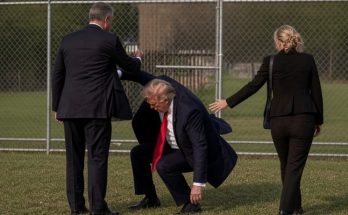
White House Press Secretary Karoline Leavitt presented statistics about President Donald Trump‘s media accessibility and contrasted his openness with former President Joe Biden‘s limited press engagement during a media event with Axios co-founder Mike Allen.
Leavitt highlighted the differences in how accessible each president has been to the media and public, noting that coverage of Biden‘s avoidance of press interactions had been largely overlooked. The exchange centered on recent changes to White House press pool protocols and whether those changes restricted media access.
During the conversation, Allen asked Leavitt about potential concerns regarding new restrictions on media access, referencing the iconic photograph taken by Evan Vucci of the Associated Press after the assassination attempt in Butler, Pennsylvania. “You have tailed access to the ‘Associated Press,’ which reaches half the world’s population every day. The most definitive photo of President Trump, the fight, fight, fight photo after the assassination attempt in Butler, Pennsylvania, was made by Evan Vucci, who’s the chief photographer in Washington for the ‘Associated Press.’ Do you worry about history being lost with these new restrictions?” Allen asked.
Leavitt characterized the changes as expansions rather than restrictions. “I don’t view them as restrictions. We view them as opening access to more outlets, more voices, more news, journalists and outlets. We shouldn’t have a few outlets who have a monopoly over the briefing room or over that 13 person press pool that covers the president,” she said.
She explained that the administration had ensured more print outlets, including Axios, had greater chances of being part of the 13-person press pool. “There are thousands of outlets who have White House press credentials. There are hundreds that actually show up every day and cover the beat. Why should a single outlet have the privilege of being in that 13 person press pool every single day,” Leavitt added.
Leavitt stated that the changes had created more transparency and accessibility. “And so the changes we’ve made have actually created more transparency, more accessibility, and greater access for a broad variety of outlets and a diversity of journalists, which I think is a good thing. And we’ve seen that play out,” she said.
Allen pressed further by referencing a statement from the White House Correspondents Association, which opposed the administration’s position changes. “The counter to that is in a White House Correspondents Association’s statement about the White House changes to the position of wire services in the pool. And the statement says the government should not be able to control the independent media that covers it. Do you agree with that statement?” Allen asked.
Leavitt rejected the premise of the Correspondents Association having authority over pool assignments. “Well, I think that a small group of journalists who comprise the board of the White House Correspondents Association should not dictate who gets to go into the Oval Office and who gets to ride on Air Force One. There should be equal access for all outlets,” she responded.
Leavitt pointed out that the administration had not restricted any outlets. “And if we were trying, by the way, to create positive press for the president, if we were trying to make it easier on him or on the administration, we wouldn’t allow some of these fake news leftist outlets in. But we continue to do that. No one has been restricted. We’ve just given more spots to more outlets and more voices,” she said.
Leavitt framed the policy shift as recognition of the digital media landscape. “It’s not about ideology. It’s just about increasing the wide variety of outlets that have access. And we live in a digital age, and we’re recognizing that at the White House. The president ran a nontraditional media campaign, which propelled him back to the highest office in the land. And we felt it was our responsibility to continue that in our coverage at the White House,” she concluded.
In July, Axios published an analysis titled “Biden’s media evasion,” which found that Biden had held fewer press conferences and media interviews than any of the last seven presidents at the same point in their respective terms. At that time, Biden had conducted 164 such events, compared to Trump‘s 468. George W. Bush had 248 and Ronald Reagan had 262.